
Provisional Sums in Renovation: What They Mean and How to Protect Your Budget
Summary: Provisional sums are estimated allowances in building contracts for work that can't be priced exactly at signing. They're a leading cause of renovation budget overruns in Australia. This guide explains what provisional sums mean, how they differ from fixed pricing and prime cost items, and what Canberra homeowners should do to protect themselves.
What Are Provisional Sums?
So what are provisional sums, and why do they show up in nearly every renovation contract?
A provisional sum is an estimated allowance in your building contract. It covers work or materials that can't be priced precisely when you sign. Think of it as a placeholder. Your builder includes a best guess for a specific part of the job. Once the work happens and the real cost is known, the contract price adjusts up or down.
The QBCC puts it this way: it's an estimate for work where the builder cannot state a definite amount when the contract is entered into. That's the provisional sum meaning building professionals use, and it applies across all states.
That sounds reasonable. And often it is. But the gap between the estimate and the final cost is what catches most homeowners off guard.
How Provisional Sums Work in Practice
Your builder includes a provisional sum of, say, $8,000 for excavation. That's their best estimate based on what they know at the time. Once the digger hits the ground and the true conditions come to light, the real cost might be $6,000. Or $14,000.
If it's less, you get a credit. If it's more, you pay the difference. Plus the builder's margin on the excess, which is typically around 20 per cent.
Unlike a variation, your builder doesn't need your approval to adjust a provisional sum. The contract already allows for it. That's why understanding these line items before you sign is so important. With provisional sums explained upfront, there are far fewer nasty surprises once work begins.
Provisional Sums vs Prime Cost Items vs Fixed Pricing
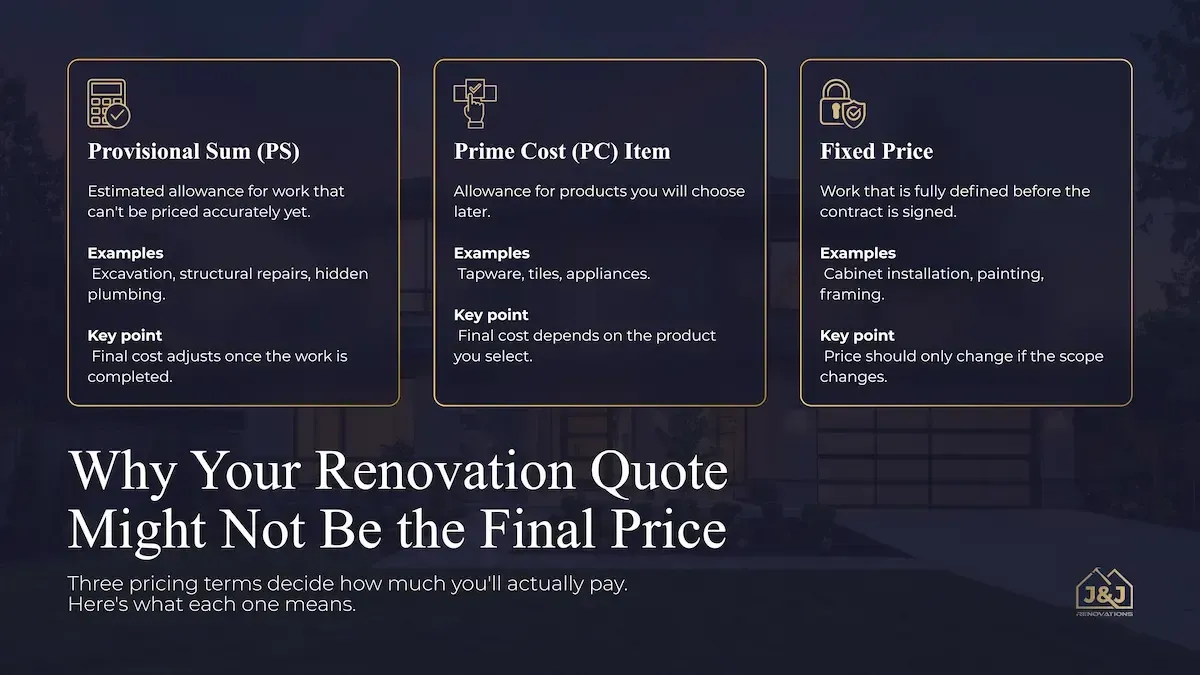
These three terms show up in almost every renovation contract. Understanding the difference between fixed price vs provisional sums (and prime cost items) is key to reading your renovation contract costs clearly.
Provisional Sum: Covers materials and labour for a complete piece of work (excavation, structural repairs, rewiring). Price certainty is low because the estimate adjusts once real costs are known.
Prime Cost Item: Covers supply of a specific product only (tapware, tiles, cooktop). Installation is fixed-price. Price certainty is medium because you choose the product and the price varies with your selection.
Fixed-Price Item: Fully scoped work with locked-in pricing. No adjustment. Price certainty is high because the price won't change.
When you're comparing quotes, look at how much of the total sits in each category. A contract heavy on provisional sums carries more financial risk. Builder provisional allowances that are vague or suspiciously low should raise questions.
When They're Unavoidable (And When They're Not)
Renovations involve more unknowns than new builds. That's the nature of working with existing structures. We can't always tell you what's behind a wall until we open it up.
Common examples of legitimate provisional costs renovation projects include:
- Excavation where ground conditions are unknown
- Structural repairs that depend on what demolition reveals
- Asbestos removal in pre-1990 homes
- Electrical rewiring in older properties
- Plumbing upgrades where pipe condition is unclear
These are legitimate reasons for a provisional sum. The scope genuinely can't be locked in until work begins.
But some builders use provisional sums for work that could be fixed-priced with a bit more investigation upfront. A soil test, an electrical inspection, or an asbestos survey before contract signing can turn an estimate into a firm number.
Our view: if something can be priced properly before you sign, it should be.
The Real Risks
Provisional sums are one of the most common causes of renovation budget overruns in Australia. Research shows that a significant percentage of Australian renovation projects exceed their initial budget, with provisional sum blowouts accounting for substantial unexpected costs.
The biggest provisional sums risks aren't the sums themselves. It's a builder who sets them unrealistically low to make their quote look cheaper.
A contract that's $15,000 less than the next quote might just have thinner provisional sums. Once construction starts and real costs come through, that gap closes fast. This is exactly why learning how to compare renovation quotes properly matters so much.
Red flags to watch for:
- Very low provisional sum amounts compared to other quotes
- Vague descriptions of what each sum covers
- A long list of provisional items when many could be fixed-priced
- Missing breakdowns showing how estimates were calculated
- Undisclosed margin percentages
What Australian Law Says
Across all states, builders are legally required to estimate provisional sums with reasonable care and skill. That's not just good practice. It's backed by implied warranties in legislation.
In NSW, builders must offer homeowners the chance to be present during provisional sum work and must provide invoices showing real costs. In Victoria, contracts must include a separate schedule breaking down each provisional sum with estimated quantities and unit costs. In Western Australia, it's a criminal offence to deliberately understate a provisional sum.
In the ACT, building contracts are governed by the Building Act 2004 and the Australian Consumer Law. Services must be rendered with due care and skill, and you can commence proceedings up to six years after a defect becomes apparent.
How to Protect Yourself
Compare quotes properly. Get at least three and compare provisional sums line by line. Not just totals. If one builder's estimates are dramatically lower, ask why. Our guide to comparing renovation quotes walks you through this step by step.
Do your own research. Get a separate excavation quote. Have an electrician assess your switchboard. Visit a tile showroom. This gives you a baseline to judge whether builder provisional allowances are realistic.
Ask the right questions. Why is this item a provisional sum and not a fixed price? What investigation could convert it? What's the best-case and worst-case? What's the margin percentage on overruns?
Get an independent contract review. A building consultant or construction lawyer can spot unrealistic allowances and unfair clauses. This small upfront cost can save tens of thousands on your overall renovation contract cost.
Budget a contingency. Industry bodies recommend 15 to 20 per cent above your contract price for renovations. For older homes, lean toward 20 per cent. That's not pessimism. It's how renovations work in practice.

How We Handle It at J&J Renovations
We don't use provisional sums to make our quotes look cheaper.
If we include one, we'll explain exactly why. We'll tell you what we know, what we don't know yet, and what we think it will cost based on our experience in Canberra. Where we can investigate upfront to lock in a price, we do.
We break down every provisional sum with a description, an estimate, and the assumptions behind it. No vague line items. No buried surprises.
If costs come in under, you get the credit. If something comes in higher, we'll talk to you about it before we proceed. We'll show you the invoices. We'll explain the options. That's true whether we're working on a kitchen renovation, a bathroom refit, or a full home rebuild.
Renovations involve uncertainty. That's unavoidable when you're working with existing homes. But the way a builder handles that uncertainty tells you a lot about how they'll handle your project.
The Bottom Line
Frequently Asked Questions
What is a provisional sum in a renovation contract?
A provisional sum is an estimated allowance for work or materials that can't be priced precisely when you sign the contract. Once the work is done and the real cost is known, the contract price adjusts up or down. Common examples include excavation, structural repairs, and asbestos removal.
How are provisional sums different from prime cost items?
A provisional sum covers both materials and labour for a complete piece of work. A prime cost item covers the supply of a specific product only, like tapware or tiles, while the installation cost sits in the fixed-price part of the contract.
Can my builder change the price of a provisional sum without my approval?
Yes. Unlike a variation, your builder doesn't need your approval to adjust a provisional sum. The contract already allows for it. That's why it's critical to understand every provisional sum before you sign.
How much should I budget for provisional sum overruns?
Industry bodies recommend budgeting a contingency of 15 to 20 per cent above your total contract price for renovations. For older homes where hidden conditions are more likely, lean toward 20 per cent.
How do I know if a builder's provisional sum is too low?
Compare at least three quotes line by line. If one builder's provisional sums are significantly lower than others, that's a red flag. Ask them to explain how they arrived at the estimate and what assumptions they've made.
Is it illegal for a builder to deliberately understate a provisional sum?
In Western Australia, it's a criminal offence. In all states, builders are legally required to estimate provisional sums with reasonable care and skill under implied warranty provisions.
What's the difference between a provisional sum and a variation?
A provisional sum is an estimate included in the original contract that adjusts based on actual costs. A variation is a change to the scope of work that requires your approval and a price adjustment to the contract.
Provisional sums renovation costs aren't something to fear. They're a normal part of renovation contracts, especially when working with older Canberra homes where hidden conditions are common.
But they are something to understand.
The difference between a smooth renovation and a stressful one often comes down to how well you understand your contract before work begins. Knowing what provisional sums mean, how provisional sums work, and what questions to ask puts you in a much stronger position.
If you're planning a renovation in Canberra and want to talk through your quotes, get in touch with us. We're happy to sit down and walk you through what the numbers mean. No pressure. Just straight talk from people who do this every day.