
How to Compare Renovation Quotes Without Getting Burned.
Most quotes look similar. They’re not.
Most renovation quotes leave out critical details. Two quotes can look the same on the surface, but be completely different once the work starts.
Missing items. Unrealistic allowances. No clear scope.
That’s how homeowners get caught out.
At J&J Renovations, we believe you should know exactly what you’re paying for before you sign anything. This guide shows you how to read, compare, and question any renovation quote with confidence.
Get clarity before you commit. No guesswork or surprises. Just a clear starting point.
What It's Like to Work with J&J Renovations
What homeowners actually value once the project starts:
Clear quotes that don’t leave things out
Pricing that makes sense before work begins
A team that explains what’s included and what’s not
Work that’s done properly the first time
Most issues in renovations don’t come from bad work. They come from unclear quotes. That’s why understanding your quote is where everything starts.
"The energy that they've brought into this project, I cannot ask for more. Everyone's so happy working away, with great energy. Thank you J&J Renovations for making this happen."
- Ana (Tuggeranong Homeowner)
You Probably Already Know What You Want
By the time most homeowners request renovation quotes, they already have a good idea of what they want.
The space they want to renovate
The style they’re going for
A rough budget in mind
At this stage, most decisions feel clear and you're ready to get started with your renovations.
But the challenge isn’t what you want, it’s making sure the quote reflects it properly.
Where things start to get unclear is the quote itself.
The challenge lies in understanding what each quote actually includes. Two quotes can look similar but be completely different once the work starts. And if you don’t know what to look for, you’re not comparing quotes properly.
Why Renovation Quotes Can Be So Different
Renovation quotes don’t vary by accident. They vary because different builders approach the scope, pricing, and detail in different ways.
Some include everything upfront. Others leave out key parts, use low allowances, or keep the scope vague.
That’s why two quotes can look similar on the surface, but be completely different once the work starts.
1. Missing Items
One of the most common reasons renovation quotes look cheaper is simple.
Sometimes important parts of the job aren’t included.
At first glance, the quote can seem complete. But once work starts, gaps in the scope begin to show up.
These items are often excluded from cheaper quotes:
Demolition and site preparation
Electrical work
Plumbing work
Fixtures and fittings (allowances too low)
Finishing work like painting or tiling
When these items aren’t included upfront, the quote appears lower than it really is.
But those costs usually show up later during the renovation as variations or additional charges
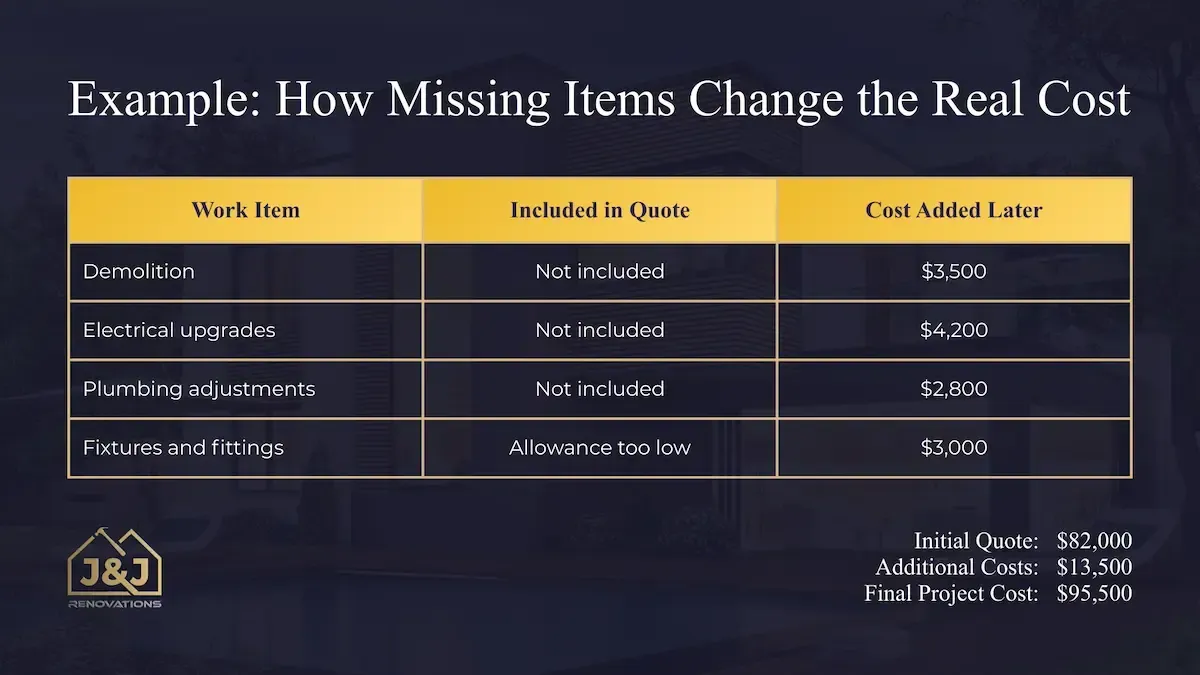
What originally looked like the cheapest quote can quickly become far more expensive.
2. Provisional Sums
A
provisional sum is an estimated allowance for something that hasn’t been fully specified yet.
This usually happens when the exact product, finish, or design hasn’t been chosen at the time the quote is prepared.
For example, a renovation quote might include an allowance for kitchen cabinetry.
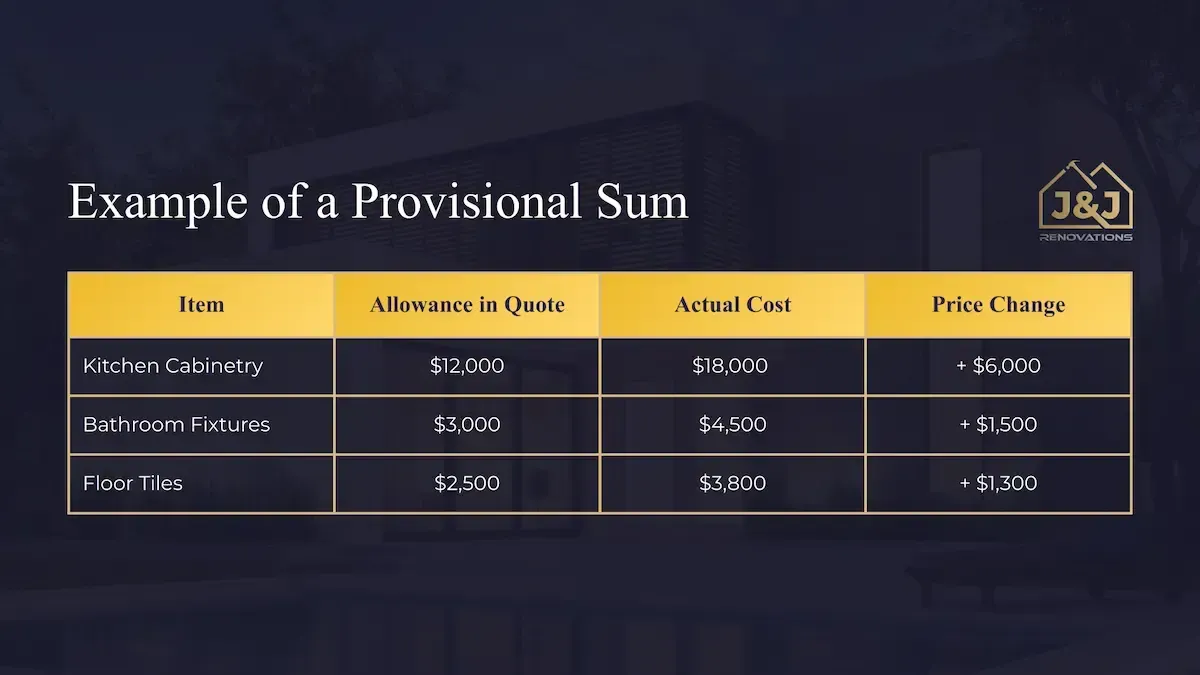
In this example, the renovation quote initially appears cheaper. But once the real products are selected, the final project cost increases.
Provisional sums are normal in renovation projects,
but large or excessive allowances can create uncertainty.
A quote with many provisional sums may mean:
Important details haven't been fully defined
Allowances may be too low
The final project cost could increase significantly
Good renovation quotes try to minimise provisional sums by specifying materials and fixtures wherever possible.
This makes the final price far more predictable for the homeowner
3. The Cheapest Quote Isn’t Always the Best Value
It’s easy to assume the lowest quote is the best deal.
But in renovations, a lower price often means something has been left out or underestimated.
A quote can look cheaper upfront for a few key reasons:
Items are missing from the scope
Provisional sums are too low
The quote lacks detailed specifications
At first glance, everything seems comparable. But once construction begins, the gaps become obvious.
That’s when the 'cheapest' quote can quickly become the most expensive.
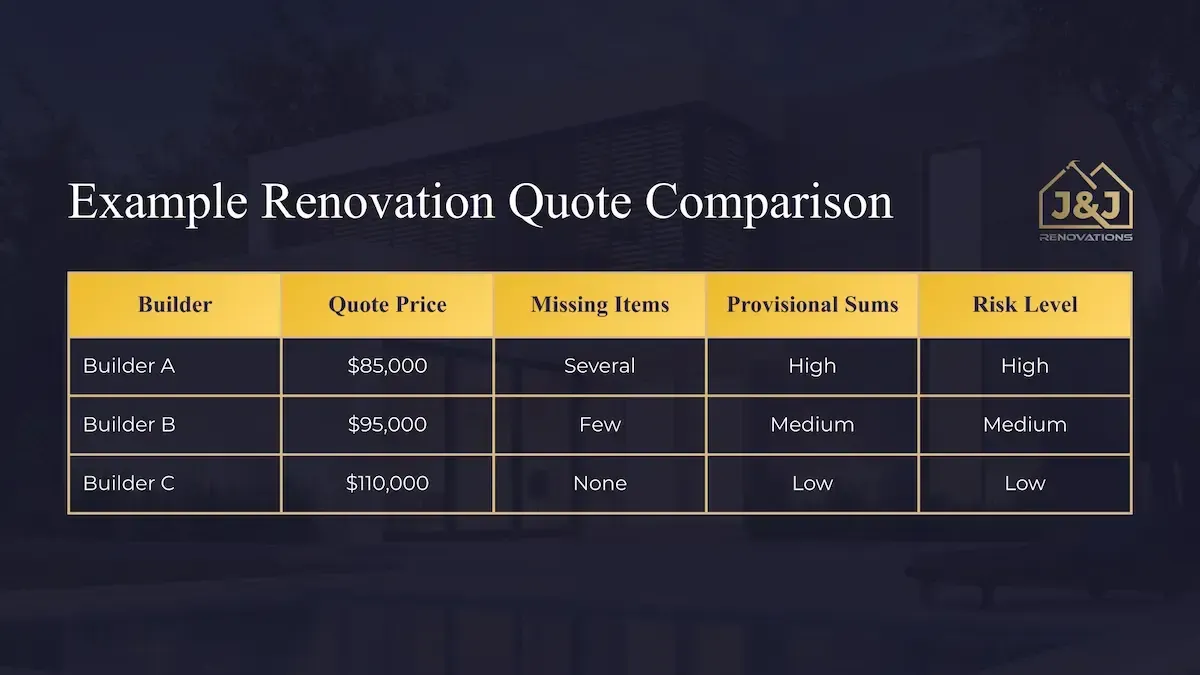
At first glance, Builder A looks like the best deal.
But if missing items and allowances are added later, the final cost can increase significantly.
The cheapest quote can sometimes end up being the most expensive project. This is why experienced builders focus on clear scope, detailed quotes, and realistic allowances.
It helps homeowners understand the true cost of the renovation before work begins.
What Most Renovation Quotes Don’t Tell You
After years of delivering renovation projects across Canberra, James from J&J Renovations has seen exactly where most projects go wrong, long before construction even begins. In this video, he breaks down what actually matters when reviewing a quote, what most builders leave out, and how to spot the details that can cost you thousands later.
If you’re planning a renovation, this is the insight that helps you compare properly, avoid surprises, and choose the right builder with confidence.
Practical Steps for Comparing Renovation Quotes
If you’re reviewing multiple quotes, here are four practical things to check.
Step 1 — Check the Scope of Work
The first thing to review in any renovation quote is the scope of work. This section explains exactly what the builder is including in the project.
A clear scope should outline all major parts of the renovation, such as demolition, structural changes, electrical work, plumbing, and finishing work.
If the scope is vague or incomplete, it becomes very difficult to compare quotes properly. Two quotes might look similar in price but include completely different work.
A detailed scope protects both the homeowner and the builder because everyone understands what is included before construction begins.
Step 2 — Review Provisional Sums
Next, look closely at the provisional sums in the quote. These are allowances for items that haven’t been fully specified yet, such as cabinetry, tiles, or fixtures.
Provisional sums are common in renovation projects, but they should be used carefully. Large allowances or vague descriptions can make the quote look cheaper while leaving the final price uncertain.
If the actual products cost more than the allowance, the difference is added to the project cost.
The more provisional sums a quote contains, the harder it is to predict the true cost of the renovation.
Step 3 — Check for Missing Items
Another important step is checking whether anything has been left out of the quote.
Some quotes exclude items like painting, flooring, lighting fixtures, cabinetry, or landscaping. These details may seem small, but they can significantly affect the total renovation cost.
When items are missing, they often appear later as variations once the project has started.
A well-prepared renovation quote should clearly list all work required to complete the space properly. This makes it much easier to understand the full project cost and avoid unexpected expenses during construction.
Step 4 — Compare Like for Like
Once you’ve reviewed the details, make sure you are comparing like for like between builders.
This means each quote should cover the same scope of work, materials, and allowances. If one builder includes demolition, electrical work, and fixtures while another does not, the quotes are not truly comparable.
The goal isn’t just to find the lowest price. It’s to understand what each builder is actually providing.
When the scope and allowances are aligned, it becomes much easier to see which quote offers the best value for your renovation.
Renovation Quote Red Flags to Watch For
Here are some common warning signs homeowners should look for when reviewing quotes.
Extremely Low Quotes
If one quote is dramatically cheaper than the others, it usually means something has been left out.
Too Many Provisional Sums
Large provisional sums create uncertainty and increase the risk of price increases during construction.
Vague Descriptions
If a quote uses general wording like:
'Kitchen works included'
without explaining what that actually covers, it’s difficult to know what you're paying for
Missing Fixtures or Finishes
Items like taps, lighting, cabinetry, and fittings are sometimes excluded.
These often appear later as additional costs.
Lack of Detail
A professional renovation quote should clearly outline the materials, scope of work, labour, allowances, exclusions, and more. If a quote is only one or two pages long, important details may be missing.
What a Professional Renovation Quote Looks Like
A professional renovation quote should do more than show a total price. It should clearly explain how that price was calculated and what work is included in the project.
In this walkthrough, we show how a properly structured quote from J&J Renovations is built, step by step.
From scope and materials to labour and allowances, you’ll see exactly what goes into a clear, transparent renovation quote.
Because when everything is laid out properly, there are fewer surprises later.
You can understand what you’re paying for, identify risks early, and compare quotes on a like-for-like basis, not just price.
Download a Real Renovation Quote Example
Want to see what a proper renovation quote actually looks like? We’ve put together a real quote you can review, use, and learn from.
Inside, you’ll see how a professional quote is structured, what’s included, and how everything is clearly broken down.
You can even use it as a reference when reviewing your own quotes or comparing builders.
See How J&J Renovations Work On Site
Watch behind-the-scenes footage of our team working on real renovation projects.
Seeing the process helps homeowners understand the care that goes into every renovation.
Designed Right From the Start
Go behind the scenes of a main bathroom renovation in its early stages, where smart planning sets everything up for a better result.
In this walkthrough, James breaks down how detailed floor plans guide every decision, from layout to functionality, including a well-zoned wet area, custom vanity, and integrated laundry space.
With the space already stripped back, the team can properly assess what’s behind the walls, avoid surprises, and order materials with precision.
It’s a clear look at how doing the groundwork properly leads to a smoother build, fewer compromises, and a finish that actually works long-term.
Where Great Renovations
Actually Begin
Most people only see the finished bathroom, but the real work happens long before that.
This early-stage walkthrough shows how planning, layout design, and site preparation come together to shape the final outcome.
From accurate drawings to material selection and structural checks, every step is about reducing risk and getting it right the first time.
At J&J Renovations, the focus is simple, treat every project like it’s our own home, so the end result isn’t just good-looking, it’s built to last.
Frequently Asked Questions
Why are renovation quotes so different?
Each builder may include different items, allowances, or levels of detail in their quote. Missing items or large provisional sums can make quotes appear cheaper than they really are.
What is a provisional sum?
A provisional sum is an allowance for an item that hasn’t been fully specified yet. If the final cost is higher than the allowance, the difference is added to the project cost.
Why is the cheapest quote risky?
Cheaper quotes sometimes exclude key work or rely heavily on provisional sums. This can lead to unexpected costs once construction begins.
How detailed should a renovation quote be?
The more detailed the quote, the easier it is to understand the real cost of the renovation.A professional renovation quote should clearly outline the scope of work, materials to be used, allowances for items, and any exclusions. Additionally, it must include a realistic project timeline.
The more detailed and comprehensive the quote is, the easier it becomes for the client to fully understand the real and total cost of the renovation project before committing to the work.
Planning a Renovation?
If you’re comparing quotes and not completely sure what they include, it’s definitely worth getting everything as clear as possible.
At J&J Renovations, we review your quote with you and walk through it line by line, so you understand exactly what’s included, what’s missing, and where costs can change.
No guesswork. No assumptions. Just clear, practical advice based on real projects.
So you can make the right decision with confidence, before any work begins.